Restored Yard Safety
Remove unstable hangers and fallen limbs so children and pets can use the yard safely.
Professional storm cleanup and hazard clearance across South Mackay properties.
Servicing South Mackay and all regional Mackay suburbs
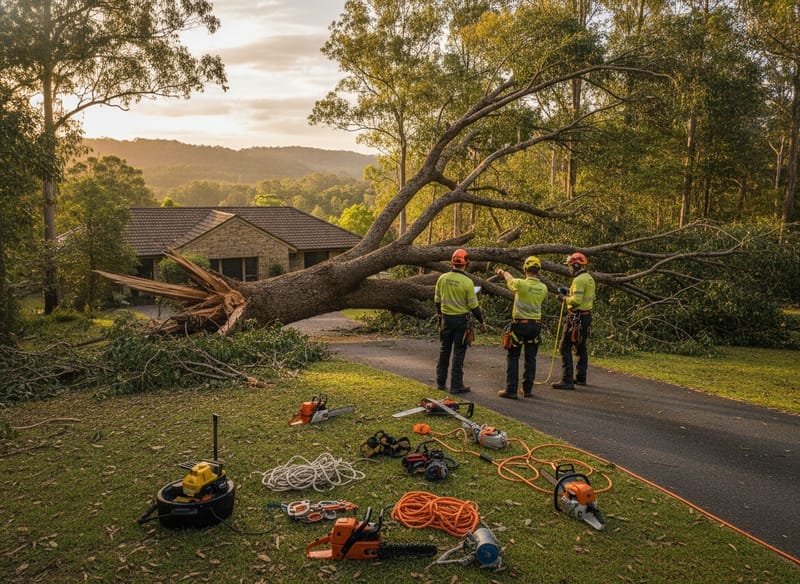
Severe weather events in Mackay often leave backyards strewn with dangerous storm debris. Our storm damage tree removal South Mackay service is focused on clearing fallen trees, removing hazardous split branches, and restoring safety to residential properties.
Pioneer catchment storm events can dump over 350mm of rain within. In South Mackay, high soil saturation combined with heavy winds causes root plate heave in mature shade trees. Cleanup prevents rot and further structural failure.
Remove unstable hangers and fallen limbs so children and pets can use the yard safely.
Clear invoices and photographic evidence help streamline your home insurance claim.
Professional remedial pruning can often save storm-damaged trees that don't require full removal.
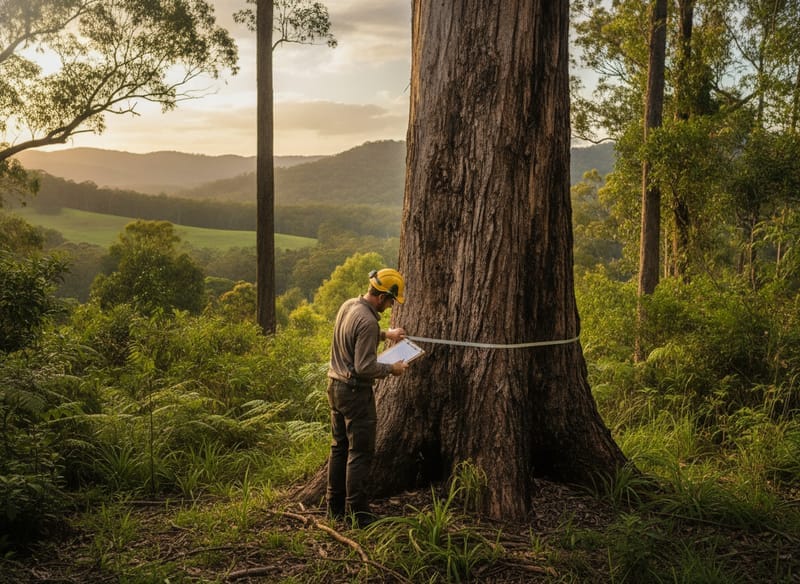
We inspect your property for cracked limbs, root heave, and overhead dangers.
We document all storm damage for your records and present a clear written cleanup plan.
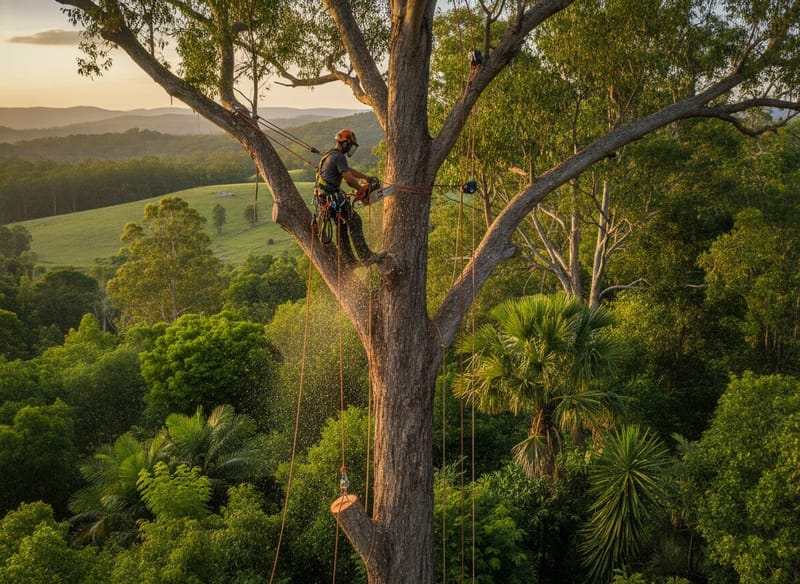
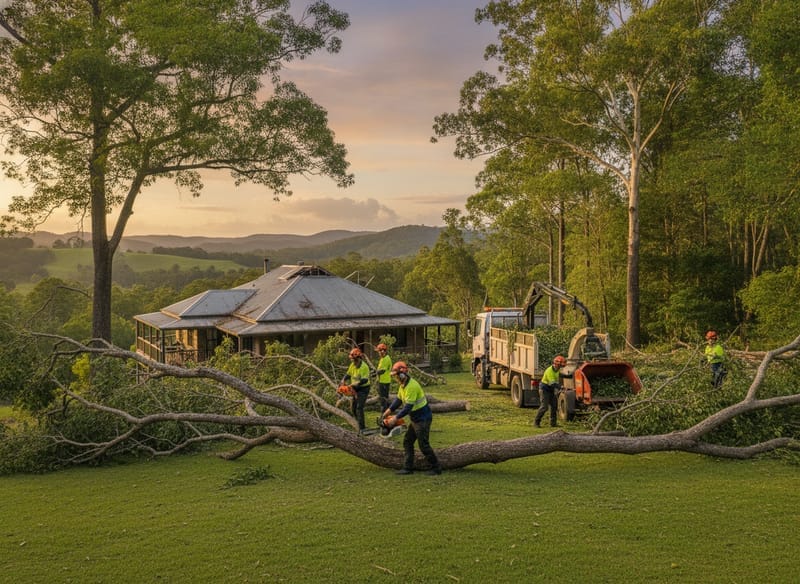
Our climbers strip dangerous hangers while ground crews process fallen timber into mulch.
We sweep down hard surfaces and haul away remaining green waste.
When severe wet season storms and tropical squalls sweep across the Mackay coastline and through the Pioneer River basin, established residential trees in South Mackay face extreme mechanical stress. Our team provides the prompt, professional Storm Damage Tree Removal South Mackay homeowners, property managers, and businesses depend on to restore safety after severe weather strikes. Saturated coastal soils combined with sudden cyclonic gusts frequently cause mature poincianas, mangoes, and raintrees to split, drop heavy scaffold branches across roofs, or suffer total root plate failure. Properties in South Mackay feature a mix of classic high-set Queenslanders, tight boundary fences, and dense canopies. When a storm-damaged tree leans over your dwelling, carports, or overhead service lines, immediate intervention by qualified arborists is essential. We arrive promptly with heavy rigging apparatus, specialized tree-clearing equipment, and wood chippers to make the site safe, systematically dismantle hazardous timber, and secure your property against secondary damage.
Attempting to cut up storm-damaged timber without professional arboricultural training is extremely dangerous. Damaged trees rarely behave like standing, stable wood. Stems and fractured canopies under tension or compression act as coiled springs; cutting into them without calculating stored energy releases can cause violent barbers-chairing, chainsaw kickback, or sudden trunk rolling, leading to catastrophic crush injuries. Unqualified contractors or well-meaning handymen often exacerbate property damage. Using incorrect felling methods or dropping heavy sections without dynamic lowering gear can crush boundary fencing, punch through iron roofs, or rupture underground utilities. Furthermore, jagged chainsaw cuts left on retained trees invite wood-decaying fungal pathogens and rapid, structurally weak epicormic growth, creating severe long-term safety hazards. Our certified arborists solve these issues through engineered rigging methods and precise structural dismantling. We utilize rated winches, dynamic lowering friction bollards, and specialized tension-release cutting techniques to neutralize mechanical forces before timber is freed. In full alignment with AS4373 (Pruning of Amenity Trees), any damaged specimens capable of being retained are pruned back to clean branch collars, while irreparably compromised trees are entirely dismantled and removed safely.
We apply technical arboricultural systems specifically tailored for high-risk post-cyclone and storm-damage environments throughout South Mackay.
Specialized chainsaw cutting techniques—including relief cuts, boring cuts, and sequential off-cuts—combined with mechanical tag lines to systematically release hazardous mechanical tension stored within bent, split, or spring-loaded trunks and limbs.
Deployment of high-capacity rigging blocks, arborist lowering friction devices, and mobile loader cranes to suspend, lift, and lower multi-tonne fractured stems cleanly away from roofs, boundary structures, and service infrastructure without ground impact.
Anchoring and securing partially uprooted or fully wind-thrown root balls with ground anchor cables and hydraulic winching before trunk severance, preventing the root plate from violently snapping back into the root crater during processing.
AQF Level 3 climbing arborists access damaged upper crowns via rope techniques or narrow-access spider lifts to eliminate hung-up broken branches (widow-makers), reduce storm-fractured branch stubs, and structurally balance retained tree crowns according to AS4373 guidelines.
On-site commercial processing of high-volume canopy debris, large limbs, and tropical palm foliage utilizing 12-inch commercial wood chippers, transforming hazardous debris into clean, usable garden mulch or carting all waste away in heavy tippers.
Complete eradication of storm-compromised or uprooted tree stumps using self-propelled commercial stump grinders, excavating wood material 150–300mm below ground level to allow safe fence reinstatement, replanting, or lawn turfing.
Following extreme weather events, our crew follows a systematic, safety-first operational protocol designed for help, efficient execution, and streamlined insurance processing. - Step 1: Emergency Triage and Risk Assessment Our senior arborist conducts an immediate site inspection to categorize hazards into triage tiers: Priority 1 covers trees on roofs, vehicles, or blocking primary access; Priority 2 includes suspended, broken limbs and severe trunk cracks; Priority 3 involves debris clearing on open turf. - Step 2: Photographic Documentation and Insurance Line-Item Quoting Prior to moving timber, we photograph all damage thoroughly and generate a comprehensive, line-item quote formatted specifically for rapid submission to Australian insurance providers and loss assessors. - Step 3: Site Securing and Make-Safe Operations Our crew establishes an exclusionary drop zone around the work perimeter, installs tension-rated anchor rigging, and neutralizes immediate structural loads to prevent any secondary movement or impact to your buildings. - Step 4: Sectional Dismantling and Controlled Lowering Our AQF-qualified climbing arborists and EWP operators dismantle the failed canopy piece by piece, using friction-controlled lowering lines to bring timber safely to the ground in tight South Mackay residential spaces. - Step 5: Chipping, Haulage, and Site Clean-Down Branch debris is processed through our high-capacity wood chippers, large log rounds are loaded for removal or cut to firewood specifications, and the entire property is blown clear of sawdust and foliage, leaving the site clean and hazard-free.
Our operations are conducted in strict alignment with AS4373 (Pruning of Amenity Trees) and national safe work standards. All tree crews are headed by certified AQF Level 3 practising arborists possessing current high-risk tickets, including Chainsaw Tree Felling (FWPCOT units), Working at Heights (RIIWHS204D), and Elevating Work Platform (EWP) operation. For intricate property damage claims, tree risk assessments, and council consultations, our AQF Level 5 consulting arborists provide certified arborist reports. We operate with comprehensive public liability insurance alongside mandatory WorkCover policies, protecting your property throughout every stage of the storm clearance.
South Mackay sits on a flat coastal plain bordering the Pioneer River mouth, where high rainfall throughout the monsoonal wet season (November to April) quickly saturates the topsoil. When severe weather systems—such as ex-Tropical Cyclone Koji—bring continuous rain and intense winds, the sandy-loam and alluvial soils lose structural friction. This drives complete root plate failure in broad-canopied species like poincianas (*Delonix regia*), backyard mangoes (*Mangifera indica*), and large raintrees (*Samanea saman*). Navigating narrow side access along classic Queenslander residences in South Mackay requires our compact spider lifts and specialized rope-access rigging rather than oversized cranes. From a planning perspective, the Mackay Region Planning Scheme 2017 and state biodiversity overlays govern vegetation clearing, while street trees on verges remain protected under Local Law 1 (Administration) 2011. Crucially, following declared natural disasters, state clearing exemptions enable property owners to perform urgent works to protect life, property, and access without prior application. We ensure all emergency Storm Damage Tree Removal South Mackay works are supported by thorough photographic records to keep you fully compliant.
Once emergency hazards have been cleared, storm-impacted trees require active monitoring to prevent delayed failures and disease. High winds often cause internal micro-fractures in branch unions that only reveal themselves weeks later.
Storm damage removal costs in South Mackay depend on the volume of debris, instability of fallen timber, and access conditions.
We supply transparent, fixed written estimates for all storm cleanup projects.
We assist property owners with storm damage removal across South Mackay and neighboring locations.
Contact our local arborist team for professional hazard removal.
Request Storm Cleanup